
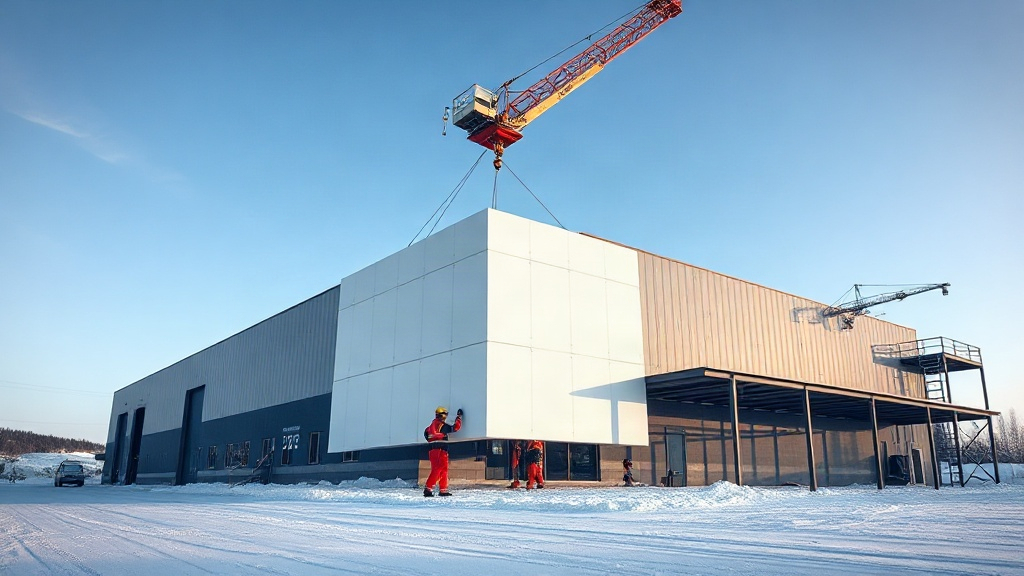
If you have ever stood inside an unfinished steel building in February, you already understand why Sandwich Panels Canada buyers obsess over core thickness and fastener details. The difference between a warm, quiet shop and one that drips condensation every morning usually comes down to choices made long before the first panel is lifted into place. This guide walks through what actually matters when you specify insulated panels for a Canadian project, from the chemistry inside the core to the way snow behaves on your roof.
What Sandwich Panels Actually Are
A sandwich panel is a composite: two rigid skins bonded to an insulating core. In Canada, the skins are usually 26 to 24 gauge pre-painted steel, sometimes aluminum or stainless for food plants and wash-down areas. The core is polyurethane (PUR), polyisocyanurate (PIR), expanded polystyrene (EPS), or mineral wool. Each combination behaves differently under heat, cold, fire, and moisture, and the price gap between them is real, so it helps to know what you are paying for.
The panels arrive as large modular units, often 1 to 1.2 metres wide and up to 12 metres long, with concealed or exposed fastening systems. Tongue-and-groove joints, factory-applied gaskets, and precise cam locks mean a crew can close in a building envelope quickly compared to stick-built walls with separate insulation, vapour barrier, and cladding.
Choosing the Core: PUR, PIR, EPS, or Mineral Wool
Polyurethane and Polyisocyanurate
PUR and PIR panels offer the highest R-value per inch, typically around R-6 to R-7 per inch of thickness depending on the manufacturer and testing conditions. PIR is chemically modified to char rather than melt when exposed to flame, which is why it shows up in commercial and institutional work where fire performance matters. For a cold-storage freezer or a retail building with strict insurance requirements, PIR is often the default.
EPS
EPS panels cost less and perform well in dry conditions. The catch is that EPS is more vulnerable to moisture migration and has a lower fire rating than PIR, so it tends to appear in agricultural buildings, temporary structures, and applications where budgets are tight and code allows it. If you are building a heated shop in Manitoba or Alberta, run the numbers on a thicker EPS panel versus a thinner PIR panel before assuming EPS is cheaper overall.
Mineral Wool
Mineral wool cores are non-combustible and excellent for acoustic control, which is why they are common in industrial buildings, mechanical rooms, and anywhere a fire separation is required. They are heavier, cost more, and have a slightly lower R-value per inch, but they hold up well where noise and fire resistance outweigh weight savings.
Thermal Performance in a Canadian Climate
R-value alone does not tell the whole story. Thermal bridging through fasteners, panel joints, and structural connections can cut effective performance significantly. Look for panels with thermal breaks at the joint, concealed clips, and gaskets that maintain continuity. A 4-inch PIR wall panel may be rated around R-26 in a lab, but the as-built wall could perform closer to R-20 if the joints are poorly detailed.
For roofs, consider the temperature gradient through the panel. In cold climates, the interior surface of a thin roof panel can drop below the dew point, and moisture from a welding shop or a busy kitchen will find it. A vapour-tight interior skin and sealed joints matter as much as thickness.
Snow Load, Wind, and Span Tables
Canadian roof design is governed by provincial building codes and the National Building Code, with ground snow loads that vary dramatically from coastal BC to the prairies and northern territories. Panel manufacturers publish span tables based on uniform load testing, but those tables assume specific support conditions. A panel that spans 3 metres in a mild climate may need intermediate purlins at 1.5 metres under a heavy snow load.
Wind uplift is the other half of the equation. Coastal and prairie sites see high gust pressures, and roof panels rely on clips, screws, and seam engagement to resist lift. Ask for the engineered span and uplift data for your specific project location, not a generic brochure table.
Fire Ratings and Code Compliance
Insulated metal panels are tested to standards like CAN/ULC-S101 for fire resistance and CAN/ULC-S134 for exterior wall fire spread. Your local authority having jurisdiction will want to see listings that match the assembly you are building, including the core type and thickness. Mineral wool panels typically achieve higher fire-resistance ratings than foam cores, but PIR panels can still meet many commercial requirements when the assembly is listed correctly. Do not assume; verify the listing against your building type and occupancy.
Cold-Climate Installation Details That Save Callbacks
- Store panels indoors or under cover before installation. Foam cores are dimensionally stable, but cold panels can be brittle at the edges and harder to handle.
- Install gaskets and sealant at temperatures within the manufacturer's range. Many sealants will not cure properly below 5°C.
- Control fastener torque. Over-driven screws crush the foam core and create a thermal bridge; under-driven screws leave gaps that leak air.
- Plan for thermal movement. Long panels expand and contract with temperature swings, so fixed and sliding connections need to be used correctly.
- Detail penetrations carefully. Every pipe, conduit, and curb is a potential leak path, so use prefabricated boots and flashings where possible.
Cost Expectations and Where the Money Goes
Panel pricing varies with core type, thickness, skin gauge, coating, and order volume. As a rough planning range, EPS panels sit at the lower end, PUR and PIR in the middle, and mineral wool at the higher end. Freight matters in Canada because panels ship on flatbeds and long lengths may require permits or specialized trailers. Ordering cut-to-length panels reduces waste but leaves less room for field adjustments. Many contractors order a few extra panels for repairs and future modifications, especially on agricultural and industrial projects where equipment gets bumped into walls.
Common Mistakes to Avoid
The most expensive mistake is treating panels as a commodity and buying on price alone. A cheaper panel with a thin skin and a poorly detailed joint can cost more in heating, condensation repairs, and rework than the savings at purchase. The second most common mistake is skipping the vapour barrier discussion on cold-storage and high-humidity buildings. Finally, do not overlook delivery logistics: a 12-metre panel needs a clear approach, a crane or telehandler, and a crew that knows how to handle it without kinking the edges.
Frequently Asked Questions
What is the best core for sandwich panels in Canada?
There is no single best core. PIR is a strong all-round choice for commercial and cold-storage buildings, mineral wool suits fire and acoustic requirements, and EPS works for budget-driven agricultural or temporary structures. Match the core to your climate, code, and occupancy.
Can sandwich panels handle Canadian snow loads?
Yes, when they are specified with the right thickness and support spacing for your location's ground snow load. Always request engineered span tables for your project site rather than relying on generic manufacturer data.
Do sandwich panels cause condensation in winter?
They can if joints are not sealed or if the interior vapour profile is wrong. Proper gaskets, sealed fasteners, and a continuous vapour control layer on the warm side prevent most condensation problems in heated buildings.
How long do insulated panels last?
With a quality coating and proper installation, the steel skins can last decades. The core performance depends on keeping moisture out, so maintaining sealants and flashing is the key to long service life.
Are sandwich panels suitable for residential buildings?
They are used in some residential and accessory buildings, but check local zoning and code requirements first. Panels are most common in commercial, industrial, agricultural, and cold-storage construction.
Getting the specification right at the design stage is far easier than fixing a cold, leaky building later. Whether you are enclosing a shop in Saskatchewan or a distribution centre in Ontario, the details behind Sandwich Panels Canada projects reward a bit of homework up front.